Selling & Money · 10 min read
How to Build Customer Trust When Selling Online in Nigeria
Practical ways Nigerian sellers can earn customer trust online: proof, clear policies, honest delivery, reviews, safe payment and after-sales care, with message examples.
By Noah Precious · Published 28 October 2026
Key takeaways
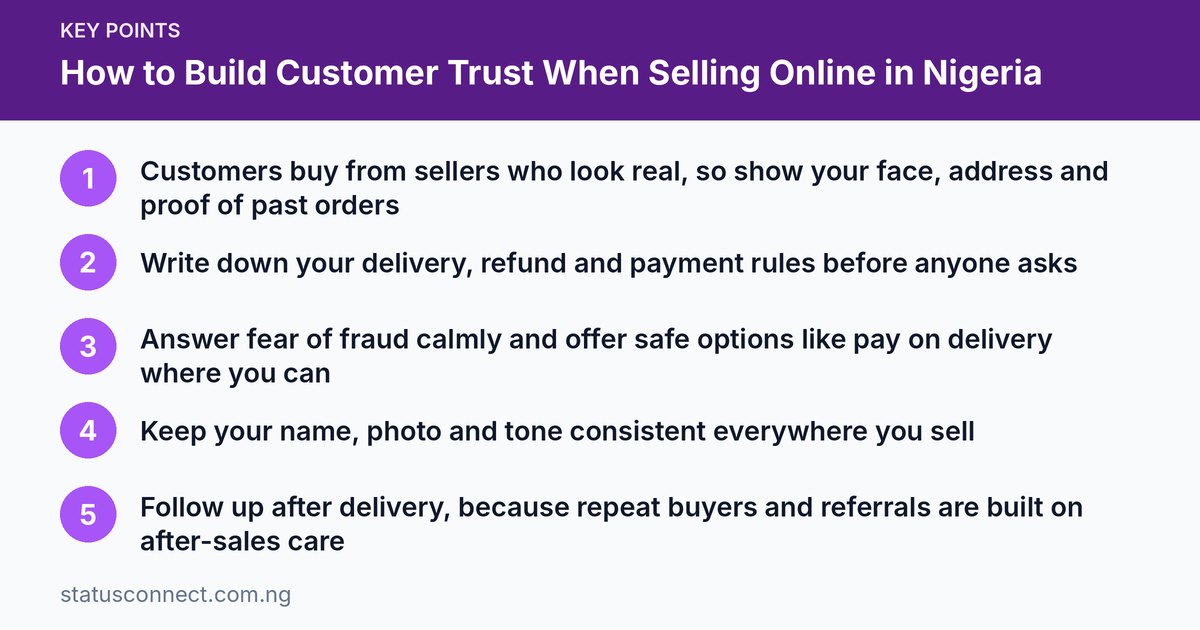
- Customers buy from sellers who look real, so show your face, address and proof of past orders
- Write down your delivery, refund and payment rules before anyone asks
- Answer fear of fraud calmly and offer safe options like pay on delivery where you can
- Keep your name, photo and tone consistent everywhere you sell
- Follow up after delivery, because repeat buyers and referrals are built on after-sales care
Ask any Nigerian who shops online and you will hear a story. Someone paid for shoes and the seller disappeared. Someone ordered a phone and received a brick. Because of stories like these, many buyers start every new conversation with suspicion. That is not rudeness. It is self-protection.
If you sell honestly, this is your opportunity. Trust is the one thing a bigger competitor cannot easily copy from you. This guide covers the practical habits that make a stranger comfortable sending you money, from your profile to your after-sales messages.
Why trust is your real product
When a customer messages you, they are asking two questions at the same time: "Is this item good?" and "Is this person real?" Most sellers only answer the first one. The second question usually decides the sale.
Trust matters even more for small sellers because buyers cannot touch the item, cannot inspect it before paying, and often cannot visit you. Every part of your presence online either lowers that worry or raises it. The good news is that most trust-building is free. It takes consistency, not a big budget.

Make it obvious that a real person is behind the business
Anonymous accounts are easy to abandon, and buyers know it. Give people reasons to believe you are accountable.
- Use a real profile photo. A clear logo works, but a photo of you or your workspace works better for many businesses.
- Complete your business profile. If you use the WhatsApp Business app, fill in your description, address, hours and links. Our WhatsApp Business setup guide walks through each field.
- Show a physical location where you can. A shop address, a market name or even the area you operate from in Lagos, Abuja or Port Harcourt makes you easier to hold accountable. If you work from home and prefer privacy, give the general area and offer a safe pickup point instead.
- Use one consistent name. If your Instagram says one thing and your WhatsApp says another, buyers wonder which one is real.
- Consider registering your business name. It is not required for every small seller, and rules and processes can change, but a registered name can reassure larger customers. See our CAC business name registration guide and the official Corporate Affairs Commission website for current requirements.
Do not fake any of this. Borrowed photos, invented shop addresses or fake registration numbers will eventually be exposed, and the damage spreads quickly through Nigerian networks.
Show proof without being boastful
Proof is simply evidence that you have done this before. You do not need hundreds of customers. You need believable examples.
- Post real delivery moments. A photo of the package before dispatch, or a short clip of you preparing orders, shows activity.
- Share customer feedback with permission. Screenshots of kind messages are useful, but ask first and cover phone numbers and private details.
- Show the process. If you bake, sew or print, show a short behind-the-scenes clip. People trust what they can see being made.
- Use your own photos. Pictures copied from other websites are a classic scam sign. Our guide to taking product photos with your phone shows how to get clear pictures without special equipment.
- Post regularly on Status. A seller who posts every few days looks alive. See content ideas for vendors if you are stuck for ideas.
One caution: never fake testimonials or edit screenshots. Customers compare notes, and one exposed fake can undo months of good work.
Be transparent about price, stock and delivery
Most disputes come from surprises. Remove the surprises.
- State the price clearly, including whether it is negotiable, and say what it covers. If you want help deciding what to charge, read how to price products on WhatsApp in Nigeria.
- Say whether the item is in stock or made to order, and how long each takes.
- Give a realistic delivery time. Promise a little more time than you need, then deliver early. The reverse pattern ruins reputations.
- Explain who pays delivery and how the fee is calculated. Be clear about what happens if the rider cannot reach the customer.
- Admit delays early. A message saying "The fabric supplier is late, your order will leave on Thursday instead of Tuesday" is far better than silence.
Silence is what breaks trust most quickly. A customer who hears nothing assumes the worst.
Write your policies down
You do not need a legal document. A short list of rules, pinned in your Status highlights, catalogue description or a saved quick reply, is enough. Cover these points:
- How to order. The steps from enquiry to confirmation.
- Payment. Which methods you accept and when payment is due.
- Delivery. Areas covered, typical timing and how you handle failed deliveries.
- Returns and refunds. What you will accept back, how long the customer has to report a problem and how refunds are made.
- Custom orders. Whether a deposit is needed and whether it is refundable.
Keep the language simple and honest. A policy you actually follow is worth more than a long one you ignore. If a law or consumer rule applies to your type of product, check current official guidance, because requirements can change.
Handle the fear of fraud calmly
Some customers will openly say, "How do I know you are not a scammer?" Do not take offence. Treat it as a reasonable question and answer it.
A helpful reply might look like this:
"That is a fair question, and I understand why you ask. Here is my shop address, my business page and a few photos of recent orders. If you prefer, we can do pay on delivery within Lagos, or you can send a small deposit and pay the balance when you see the item. I will send you a video of the exact item before dispatch."
Options that reduce buyer risk include:
- Pay on delivery within an area you can reach reliably.
- A deposit and balance structure for higher-value or custom items.
- A video call or short video of the exact item the customer will receive.
- Meeting in a public, safe place for pickups, ideally in daylight.
- Sharing your business details such as your business name and the account name that will appear when they transfer.
Be honest about what you cannot offer. If pay on delivery is not possible in a customer's town, say so and explain the alternative. For safer collection methods and how to avoid fake alerts as a seller, read how to accept payments safely on WhatsApp.
Verify the buyer too
Trust has to go both ways. Fake payment alerts and fake riders are common enough that careful sellers protect themselves.
- Confirm payment in your bank app, not from a screenshot or an SMS alone.
- Be careful with overpayment stories. If someone "accidentally" sends too much and asks you to return the difference, check your actual balance and your bank's guidance before doing anything.
- Use the same rider or dispatch service consistently so you know who has collected an order.
- Be careful with unusual requests, such as a buyer who wants to send their own unknown courier at the last minute.
Showing buyers that you take verification seriously also makes you look professional. Our article on spotting WhatsApp scams in Nigeria lists patterns worth recognising on both sides of a deal.
Keep your brand consistent
Consistency is quiet proof. A seller who looks the same everywhere feels established.
- Use the same name, logo and colours across WhatsApp, Instagram and any marketplace listing.
- Keep a steady tone. Warm, clear and respectful works better than shouting in capital letters.
- Reply in a predictable window. If you only answer in the evening, say so in your profile or away message.
- Keep your number stable. Changing numbers often makes customers think you disappeared. Protect it with two-step verification.
- Fix spelling and price errors quickly and admit mistakes when they happen.
Message examples you can adapt
Having ready wording makes trust-building easier on busy days. Edit these to match your style.
Order confirmation: "Thank you for your order. You have ordered one pair of black leather sandals, size 42, for the agreed price. Delivery is to Wuse in Abuja and should reach you within the time we discussed. I will send the rider's details once the item is dispatched."
Delay notice: "Good morning. I want to be honest with you. Your order is running one day late because of a supplier delay. I am sorry for the inconvenience. I will update you tomorrow by noon with the new dispatch time."
Dispatch update: "Your order has been dispatched. Here is the rider's name and number. Please keep your phone on, and tell me as soon as it arrives."
Problem report: "I am sorry the item did not meet your expectation. Please send a photo or short video of the problem, and I will tell you what I can do under my return policy."
Notice the pattern: specific details, no pressure and a clear next step.
After-sales care builds repeat buyers
The sale is not finished when the money arrives. After-sales messages turn first-time buyers into regulars and referrals.
- Confirm delivery. Ask whether the item arrived in good condition.
- Ask for honest feedback a few days later, and thank them either way.
- Fix problems quickly. A customer who sees you handle a mistake well often trusts you more than one who never had a problem.
- Save customer details properly and respect their privacy. Our guide to the Nigeria Data Protection Act and WhatsApp contacts explains the basics, and the Nigeria Data Protection Commission website has the official information.
- Invite them to your community. Customers who stay connected see your updates. You can also encourage them to join the Status Connect community.
Mistakes that destroy trust
- Promising delivery dates you cannot keep.
- Going silent after payment.
- Using photos that are not of your actual item.
- Pressuring buyers with "Pay now or lose it" on every message.
- Refusing to explain your policies.
- Deleting chats or blocking customers who complain instead of solving the issue.
- Mixing up orders because you have no record system.
Most of these are habits, not character flaws. A simple notebook or label system in your phone prevents many of them.
Frequently asked questions
What is the fastest way to look trustworthy as a new seller?
Complete your profile with a real photo and clear description, post your own product photos regularly and answer every enquiry politely and promptly. Offer a safe option such as pay on delivery or a small deposit where you can.
Should I offer pay on delivery?
It reduces the buyer's risk, but it also increases yours if customers refuse parcels. Use it in areas you can reach reliably, for items you can resell, and consider a small deposit for expensive or custom orders.
How do I respond to a customer who says I am a scammer?
Stay calm and do not argue. Share verifiable details such as your business page, location where appropriate and recent order proof, and offer a safer payment arrangement. If they still decline, let the sale go politely.
Do I need to register my business to be trusted?
Not always. Many small sellers operate without registration, but a registered name can help with bigger customers, bank accounts and partnerships. Requirements and processes can change, so check the official CAC website for the latest.
Final thoughts
Trust is built in small, boring, repeatable actions: a clear price, an honest delay message, a quick reply, a refund handled fairly. None of these are expensive. Do them consistently and your reputation will grow through the same networks that scare buyers today. If you want help connecting with more genuine buyers and sellers, you can learn more about Status Connect or read about how to get customers without ads.
*Laws, platform rules and bank procedures can change, so confirm current details with official sources before making important decisions.*