Selling & Money · 7 min read
How Nigerian Freelancers Can Find Clients on WhatsApp Without Spamming
A practical guide for Nigerian freelancers on finding, pitching and keeping clients on WhatsApp, with profile setup, Status strategy, outreach scripts, pricing and boundaries that protect your account.
By Noah Precious · Published 17 August 2026 · Updated 28 October 2026
Key takeaways
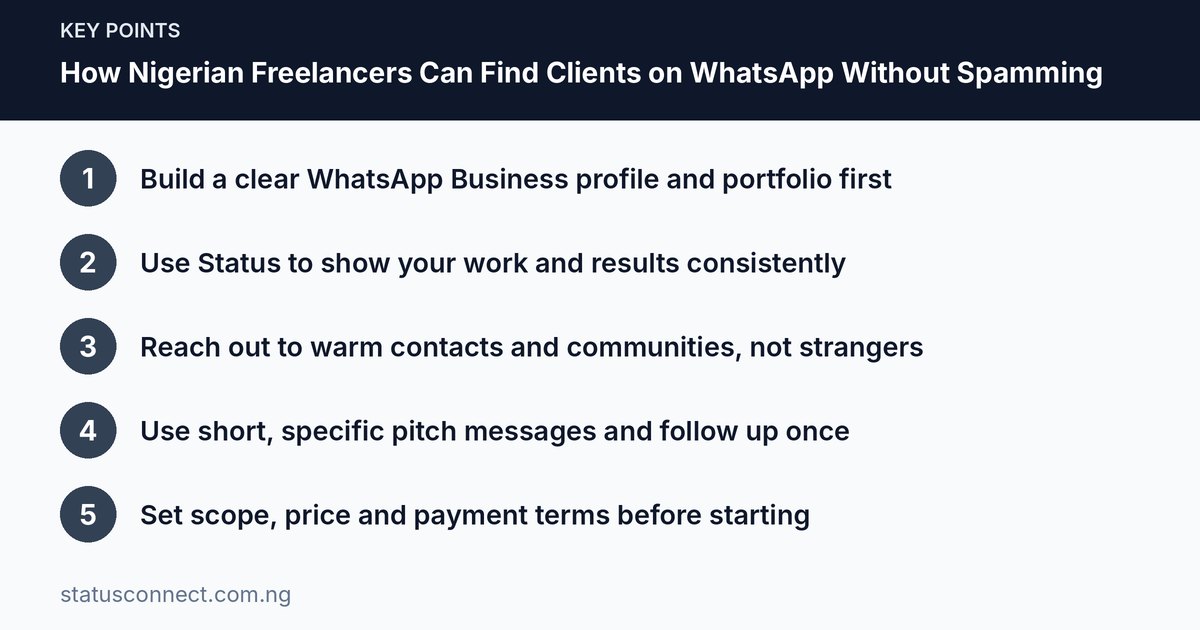
- Build a clear WhatsApp Business profile and portfolio first
- Use Status to show your work and results consistently
- Reach out to warm contacts and communities, not strangers
- Use short, specific pitch messages and follow up once
- Set scope, price and payment terms before starting
Freelancers in Nigeria, from designers and writers to photographers and developers, often find work through WhatsApp. It is direct and personal, but the same features that make it powerful make it easy to annoy people. Sending the same pitch to hundreds of strangers can get you blocked or banned. This guide shows a better approach: build a professional presence, share your work consistently, reach the right people respectfully and run projects in a way that earns referrals.
Step 1: Get your foundations right
Use the WhatsApp Business app
It gives you a profile, catalogue, quick replies and labels. Fill in a clear business name, category, description and email. Our setup guide explains each step.
Describe what you do in one line
"I design logos and brand kits for small businesses in Lagos" is better than "Graphic designer." Say who you help and with what.
Build a simple portfolio
Create a short portfolio in a PDF, a free website, Behance, GitHub or a Google Drive folder. Show three to six of your best projects with a sentence about the problem and the result. Use your catalogue to list services and starting prices, or at least packages.
Collect proof
Ask past clients for short testimonials and permission to show their work. Screenshots of kind messages, with names or numbers hidden if needed, help new clients trust you.
Step 2: Use Status to show your work
Your Status is a free daily showcase for everyone who has saved your number.
- Post results, not only promotions. Before and after, finished designs, published articles and live websites.
- Share process, such as sketches, drafts and behind-the-scenes.
- Share short tips related to your skill. Teaching builds authority.
- Post client wins with permission.
- Add a clear call to action, like "Need this for your business? Message me."
Posting three to five times a day is not necessary for freelancers; one or two good posts is enough. Our guides on Status content ideas and the best time to post help you plan. To grow the audience that sees them, read about building a WhatsApp network.
Step 3: Find clients the right way
Warm contacts first
Tell friends, family, former colleagues and classmates what you do, and ask if they know someone who needs it. Referrals are the best source of freelance work.
Communities and platforms
Join professional communities, alumni groups and local business groups. Offer help, answer questions and share useful resources. Do not post adverts in every message. Check group rules first.
Local businesses
Identify small businesses with weak online presence, such as unclear photos, no logo or outdated websites. Prepare a short, personal observation and offer a specific improvement. This works better than generic mass messages.
Contact exchange communities
Reciprocal communities such as Status Connect can expose your Status to more business owners who might need your services. Treat those contacts as potential clients, not a list to blast.
Other platforms
Use LinkedIn, X, Instagram and freelancing marketplaces to find leads and then move serious conversations to WhatsApp.
Step 4: How to write a pitch that gets a reply
Keep it short, personal and specific. A good structure:
- Greeting and context. Who you are and how you found them.
- Observation. One specific thing you noticed.
- Offer. How you can help and one proof point.
- Easy next step. A question they can answer quickly.
Example
"Hi Mrs Bello, I'm Tunde, a brand designer in Lagos. I saw your bakery's Instagram and loved your cakes, but the logo looks different on each post. I helped a bakery in Ikeja make its branding consistent and their orders increased. Would you like me to send a quick sample for your page?"
Rules
- Do not paste the same text to everyone. Customise each.
- Follow up once or twice, a few days apart. Then stop.
- Do not add people to groups.
- Respect no. A polite "Thanks, I will not bother you again" leaves a good impression.
See the WhatsApp marketing rules to avoid restrictions.
Step 5: Price and agree terms
Poor agreements cause most freelance problems. Before you start:
- Define the scope: what is included, how many revisions and the deadline.
- Set the price and payment schedule. A common approach is a deposit before starting, with the rest on delivery. See our guide to pricing and safe payments.
- Put it in writing, even if it is a simple WhatsApp message summarising the agreement and asking the client to confirm.
- Keep files until paid, or deliver watermarked previews.
Step 6: Communicate like a professional
- Reply within a reasonable time and set working hours using your away message.
- Send progress updates at agreed points.
- Keep client chats organised with labels such as Lead, Active, Waiting for feedback and Paid.
- Use voice notes only if the client prefers them; written summaries are easier to refer to later.
- Be honest about delays and limits.
Step 7: Keep clients and get referrals
After delivery, ask for feedback and a short testimonial. Check in a month later. Offer a small thank-you for referrals. Add clients' work to your portfolio with permission and update your Status with new wins.
Step 8: Protect yourself
Scammers target freelancers with fake clients, overpayment tricks and requests for unpaid "samples." Never share verification codes, and be wary of anyone who wants to pay you through unusual routes. Read 10 common WhatsApp scams and secure your account with two-step verification.
Handling difficult client situations
Even good freelancers meet awkward clients. A few examples and how to respond calmly:
- The client who keeps adding work. Refer back to the agreed scope. Say, "That is outside what we agreed, but I can quote it as an extra." Do not quietly absorb the cost.
- The client who disappears after delivery. Send one polite reminder with the invoice, then another a few days later. Keep the final files until payment is confirmed.
- The client who wants a free sample. Offer a small paid trial or a sample from your existing portfolio instead of custom unpaid work.
- The client who haggles hard. Reduce the scope instead of the price. "For that budget I can do two logo options instead of four."
- The client who is slow to give feedback. Set deadlines in the agreement, such as "feedback within three days, otherwise the timeline moves."
Frequently asked questions
Should I use my personal number or a separate business number?
A separate number is better because it keeps work and private chats apart, and it protects you if you ever need to change it. If you only have one phone, the WhatsApp Business app can run on a second number. Our guide on WhatsApp Business versus WhatsApp Messenger explains the difference.
How many pitches should I send in a day?
Quality matters more than numbers. Five thoughtful messages to people who might genuinely need your service will do more than fifty copied ones, and they keep your account safe.
What if a client wants to pay in advance but I have not started?
That is fine and common, but still write down the scope and issue a receipt. Do not accept unusual overpayments, and never refund until the original payment has fully cleared.
How do I show results if I am just starting?
Create two or three practice projects for imaginary or friendly clients, or offer a discounted first project in exchange for a testimonial. Real work, even small, beats a long list of skills with no examples. Trust grows quickly when people can see proof, as explained in building customer trust online.
A four-week plan
Week 1: Set up your Business profile, portfolio and pricing. Week 2: Post work and tips on Status daily and tell your warm contacts. Week 3: Send ten personalised pitches and join two communities. Week 4: Follow up, ask for testimonials and review which channels brought leads.
Consistency and professionalism, not spam, will bring you steady clients.