Selling & Money · 9 min read
How to Get Customers Without Paid Ads in Nigeria
Practical, low-cost ways to win customers in Nigeria without paid ads: referrals, WhatsApp Status, Google Business Profile, partnerships, reviews and a weekly routine.
By Noah Precious · Published 28 October 2026
Key takeaways
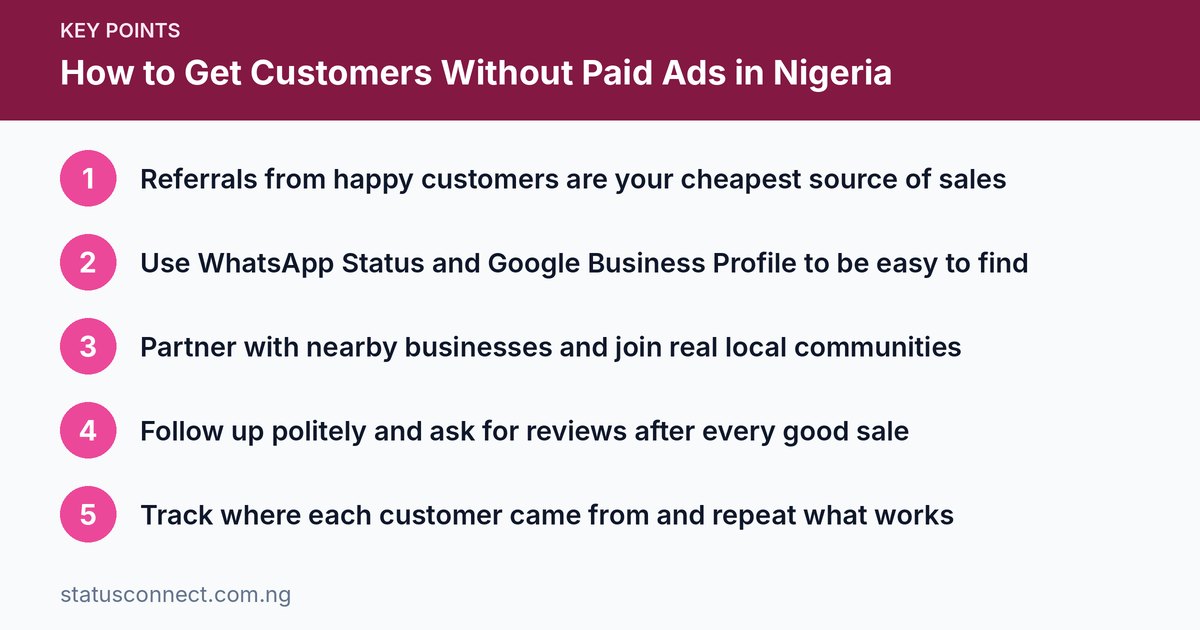
- Referrals from happy customers are your cheapest source of sales
- Use WhatsApp Status and Google Business Profile to be easy to find
- Partner with nearby businesses and join real local communities
- Follow up politely and ask for reviews after every good sale
- Track where each customer came from and repeat what works
Paid ads can work, but many small Nigerian businesses cannot afford to burn money on boosted posts while they are still learning who their customers are. The good news is that most small businesses grow first through people, not adverts: a friend who recommends you, a neighbour who sees your work, a customer who comes back. This guide gives you practical ways to find and keep customers without paying for ads, plus a simple weekly routine and a way to measure what is working.
None of these ideas is magic. They take consistency. But they cost very little money, and they build trust that ads alone cannot buy.
Start with the people who already know you
Before you try to reach strangers, look at who is already close to your business.
- Past customers. Anyone who has bought from you once is more likely to buy again than a stranger is to buy the first time.
- Friends, family and colleagues. Tell them clearly what you sell and who you serve. Do not just say "support my business." Say "I make school uniforms in Surulere. If you know any parent who needs them, please send them my way."
- Your phone contacts. Many people have hundreds of saved contacts they never message. Our guide on growing your WhatsApp network in Nigeria explains how to build a contact list that actually sees your posts.
The first ten customers usually come from this circle, so give it real effort.
Build a simple referral habit
Referrals work because people trust people they know. You do not need a complicated system.
- After a successful delivery, thank the customer and ask: "Do you know anyone else who might need this?"
- Make it easy. Send a short message they can forward, with your name, what you sell and a link to start a chat.
- Say thank you in a real way. This could be a small discount on their next order, a free small item or a public thank-you with their permission. Do not promise rewards you cannot afford.
- Keep a note of who referred whom, so you can reward and remember them.
You can create a direct chat link and a QR code in a few minutes. Our guide on WhatsApp click-to-chat links and QR codes shows how, and it is useful on receipts, packaging and flyers.
Use WhatsApp Status like a shop window
Your Status is free, it reaches people who already have your number, and it disappears after 24 hours, so you can post often without clutter. Treat it as a shop window rather than a noticeboard for adverts.
- Show real products, work in progress, delivery moments and customer feedback (with permission).
- Mix selling posts with helpful or personal ones. If every post says "buy now," people will skip them.
- Post at times when your customers are likely to be on their phones.
Three articles will help here: how to increase WhatsApp Status views, content ideas for vendors and the best time to post. Good photos matter too, and you can make them with only your phone, as we explain in product photos with your phone.
Be found on Google for free
Many customers search on their phones for things like "caterer near me" or "tailor in Yaba." A free Google Business Profile can help local customers find you if your business serves a physical area or has a place customers visit.
- Search for the Google Business Profile help pages on Google support for the current steps, since screens and rules change.
- Use your real business name, correct address or service area, opening hours and phone number.
- Add clear photos of your products, shop or work.
- Choose the category that best matches what you do.
- Reply politely to every review, good or bad.
Be honest in your details. Fake addresses or keyword-stuffed names can lead to your listing being removed. Ask your first happy customers to leave a review, which we cover below.
Join local communities properly
People buy from those they see regularly. Find places where your customers already spend time:
- Estate or street WhatsApp groups, church or mosque groups, alumni groups, market associations and professional groups.
- Local events, bazaars and trade fairs, where you can meet customers and other sellers in person.
- Online communities related to your niche, such as parents, students or small business owners.
A few rules will keep you welcome. Read the group rules first. Be helpful before you sell: answer questions and share tips. Do not add people to groups without asking them, and do not flood groups with price lists. If you want to understand which groups and communities fit best, see WhatsApp Groups vs Communities and our summary of what is allowed in WhatsApp marketing.
Partner with businesses that share your customers
Look for businesses that serve the same people but sell something different. A baker can partner with an event decorator. A hair stylist can partner with a makeup artist. A phone accessories seller can partner with a phone repair shop.
Simple partnership ideas:
- Recommend each other to customers.
- Leave a few business cards or flyers at each other's shops.
- Run a joint small offer, such as a gift pack.
- Share each other's work on Status, with agreement.
Pick partners whose quality you trust, because their mistakes will reflect on you.
Share useful content
Content does not need to be fancy. It simply answers your customer's questions before they ask.
- A food seller can post how to store and reheat meals, and how to order for a party.
- A fashion seller can post how to measure correctly and how to care for different fabrics.
- A service provider can post a before-and-after of a job, with the customer's approval.
Useful posts make people trust your expertise, and they give customers something to forward. For product pages and posts, our guide on writing product descriptions that sell can help you be clear and honest.
Collect reviews and proof
New customers often ask, "Is this person real?" Proof answers that question.
- Ask satisfied customers for a short comment after delivery. Make it easy: "Could you tell me in one line how it went?"
- Ask permission before sharing screenshots, and remove personal details such as phone numbers and account numbers.
- Never invent reviews or pay for fake ones. It breaks trust and can be against platform rules.
- Share how you handled a complaint. A calm, fair response can build more confidence than a perfect record.
More ideas are in our guide on building customer trust online in Nigeria.
Follow up without being annoying
Many sales are lost because nobody follows up. A polite, short message can bring a lost customer back.
- When someone asks for a price and goes silent, send one reminder after a day or two.
- After delivery, check that everything is fine.
- Remind past customers when a product they like is restocked, but only if they are happy to hear from you.
- Stop if someone says they are not interested.
Respect people's preference. Personal data you hold, such as phone numbers, should be handled responsibly, and our article on the Nigeria Data Protection Act and WhatsApp contacts explains the basics.
A simple weekly routine
Consistency beats bursts of effort. Here is a routine you can adjust to your own schedule.
- Monday: Review last week's orders. Note who bought, who asked but did not buy, and where they came from.
- Tuesday and Thursday: Post two or three Status updates each day, including one helpful or behind-the-scenes post.
- Wednesday: Follow up with enquiries from the last week and with recent customers.
- Friday: Ask two or three recent customers for feedback or a review, and update your Google listing photos if you have new ones.
- Saturday: Spend thirty minutes in one community, either helping or meeting a potential partner.
- Sunday: Plan next week's posts and offers, and check your stock.
Measure what works
You do not need expensive tools. Keep a notebook or simple sheet with each new customer and ask, "How did you hear about me?" Record the answer. After a month, count: how many came from referrals, Status, Google, groups or partners?
Then decide:
- Do more of the source that brings the most paying customers.
- Fix or drop the source that brings only enquiries and no sales.
- Test one change at a time, so you know what caused the improvement.
Also track repeat customers. If many buy once and never return, the issue may be quality, price or follow-up, not visibility.
Mistakes to avoid
- Posting only prices and "DM to order" with no personality or proof.
- Adding strangers to groups or broadcast lists without consent.
- Copying competitors' photos or content.
- Promising delivery times you cannot meet.
- Quitting after two weeks because results are slow.
Frequently asked questions
How long does it take to get customers without ads?
It depends on your product, area and effort. Many sellers see their first sales from people they know within days, while steady growth from referrals and search takes longer and needs consistency.
Is it free to use Google Business Profile?
Creating a listing has generally been free, but features and policies can change, so check the official help pages on Google support for the latest information.
Can I send promotional messages to everyone in my contacts?
Be careful. People should expect to hear from you, and unwanted messages can lead to complaints or restrictions. Read WhatsApp's official rules at the WhatsApp FAQ and keep your messages relevant.
What should I do if people ask for my price and disappear?
Send one friendly follow-up, make your price and delivery details clear, and add proof such as photos or reviews. If they still do not reply, move on without pressure.
Final thoughts
Getting customers without ads is mostly about being visible, useful and reliable, again and again. Pick two or three ideas from this guide, run them for a month, measure the result and keep what works. If you want to meet more sellers and buyers while you build your network, you can join the Status Connect community.