Security & Privacy · 7 min read
10 Common WhatsApp Scams in Nigeria and How to Spot Them Before You Lose Money
The ten most common WhatsApp scams targeting Nigerians and small businesses, with warning signs, real-life examples, what to do if you are targeted and where to report fraud.
By Noah Precious · Published 20 July 2026 · Updated 28 October 2026
Key takeaways
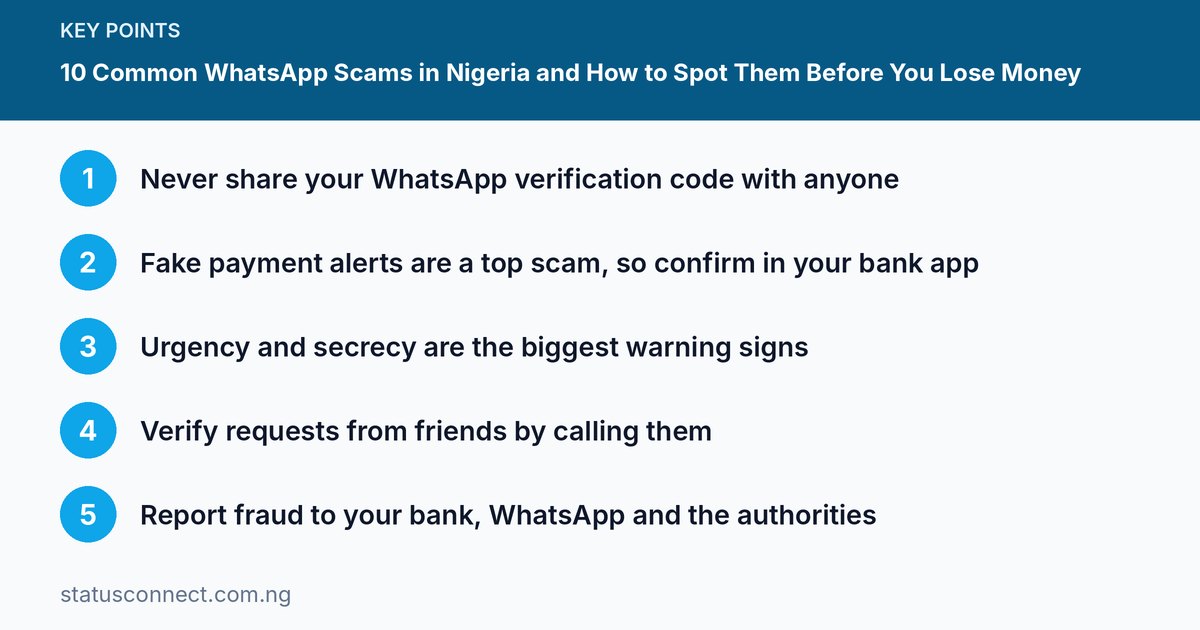
- Never share your WhatsApp verification code with anyone
- Fake payment alerts are a top scam, so confirm in your bank app
- Urgency and secrecy are the biggest warning signs
- Verify requests from friends by calling them
- Report fraud to your bank, WhatsApp and the authorities
WhatsApp is where Nigerians chat, shop and do business, so it is also where scammers go to work. Many scams are simple and rely on speed, fear or excitement. Anyone can be fooled, including smart and careful people. This guide describes the ten most common WhatsApp scams, shows the warning signs and explains what to do if you think you have been targeted.
1. The verification code scam
How it works: You get an SMS with a six-digit WhatsApp code you did not request. Soon after, a contact (whose account has already been hijacked) messages: "Please I sent you my code by mistake, can you send it to me?" If you do, the scammer takes over your account.
Warning signs: A friend asks for a code, urgently and by text. The code was not requested by you.
Protect yourself: Never share your code with anyone, for any reason. Turn on two-step verification. See how to protect your WhatsApp number.
2. The hijacked friend or relative
How it works: You get a message from a friend's account asking for money, airtime or data because of an emergency. The account is controlled by a scammer.
Warning signs: The request is urgent, the friend will not take a call and the account details are for someone else.
Protect yourself: Call the person on a normal voice call or ask a question only they could answer. Do not send money based on a chat alone.
3. Fake payment alerts and receipts
How it works: A buyer sends a screenshot or fake SMS alert showing they paid, then pressures you to release goods quickly. No money arrived.
Warning signs: Screenshots rather than bank notifications, rush, overpayment or a request for a "refund" of extra.
Protect yourself: Confirm money in your bank app or account statement, not in a screenshot or an SMS. Read how to accept payments safely when selling on WhatsApp.
4. Fake job and visa offers
How it works: Someone offers a job or visa and asks for an "application fee," "training fee" or "document processing fee."
Warning signs: Fees before work, guaranteed visas, a personal WhatsApp account instead of an official email and a company that you cannot verify.
Protect yourself: Check the company on official websites and the Corporate Affairs Commission registry. Real employers do not charge application fees.
5. Fake investment and "double your money" schemes
How it works: You are added to a group where members post screenshots of huge profits. An admin offers to trade or invest for you. After a few small payouts, you are urged to invest more, then the group disappears.
Warning signs: Guaranteed returns, secret strategies, pressure to recruit others and payment into personal accounts.
Protect yourself: If an investment promises high returns with no risk, assume it is a scam. Check registration with the Securities and Exchange Commission before you send money.
6. Delivery and logistics scams
How it works: You receive a message saying a package is waiting and you must pay a fee or click a link.
Warning signs: You did not order anything, the link goes to an unfamiliar site and the sender asks for card details.
Protect yourself: Do not click. Contact the courier through its official website or phone number.
7. Fake giveaways and loans
How it works: A message claims you won a prize, a data bundle or a loan. To claim it, you need to share personal data, pay a "processing fee" or forward the message to many contacts.
Warning signs: You never entered a contest, requests to forward messages, pay a fee or share a code.
Protect yourself: Ignore and delete. Real prizes do not require you to pay.
8. Fake customer support and bank messages
How it works: Someone claiming to be from your bank, a mobile network or WhatsApp asks for your PIN, OTP or card details to "fix a problem."
Warning signs: Unsolicited contact, requests for secrets and pressure.
Protect yourself: Banks and WhatsApp will never ask for your PIN, OTP or password. Hang up and call the official number on your card or the bank's website.
9. Fake sellers and "too cheap" products
How it works: A seller offers phones, cars, laptops or land at very low prices, takes a deposit and vanishes.
Warning signs: Prices far below the market, stock photos from other sellers, no physical address and refusal to meet in person or pay on delivery.
Protect yourself: Search the seller's name and number, ask for a video of the item, prefer pay-on-delivery for small purchases and meet in public places for big ones.
10. Romance and blackmail scams
How it works: A friendly stranger builds a relationship, then asks for money, or tricks you into sharing private photos and later demands payment.
Warning signs: Fast declarations of love, refusing video calls, urgent money needs and threats.
Protect yourself: Do not send money or private photos to someone you have not met. If blackmailed, stop paying, keep evidence and report it.
Red flags that show up in almost every scam
- Urgency. "Do it now or lose it."
- Secrecy. "Do not tell anyone."
- Unusual payment methods. Gift cards, crypto or personal accounts.
- Requests for codes, PINs or passwords.
- Too good to be true.
- Poor details. Mismatched names, copied photos and inconsistent stories.
What to do if you have been scammed
- Stop all contact and do not send more money.
- Secure your account. If WhatsApp was hijacked, re-register your number to log the scammer out, then enable two-step verification. WhatsApp's help pages explain account recovery.
- Contact your bank immediately if you sent money. Ask them to flag the transaction. Speed matters.
- Report to the authorities. In Nigeria you can report fraud to the Economic and Financial Crimes Commission (EFCC) and the police.
- Warn your contacts if your account was hijacked so they do not fall for the scammer's messages.
- Keep evidence. Screenshots, account numbers, phone numbers and chat history.
Frequently asked questions
Can someone hack my WhatsApp just by knowing my number?
Not by number alone. They also need the six-digit code sent to your phone, or access to your phone itself. That is why scammers try to trick you into handing over the code, and why two-step verification is so valuable.
I clicked a suspicious link. What should I do?
Do not enter any details. Close the page, clear the browser history, and if you typed a password or card details, change the password and call your bank straight away. Run a security scan using your phone's built-in protection.
Is it a scam if a stranger messages me about a business offer?
Not always, but treat it as unverified until proven otherwise. Check the person's name and number online, ask for a video call and never pay money before you have confirmed who they are. Honest people understand caution.
How can I tell if a seller is genuine?
Look for a consistent history: real photos taken by the seller, reviews from people you can contact and a willingness to use safe payment methods. Our guide on building customer trust online lists the signs genuine sellers show.
Teach your family and staff
Scams succeed most often against people who have never heard of the trick. Take ten minutes to explain the verification code scam to parents, relatives, staff and friends. Agree a family rule, for example that nobody sends money after a chat message alone without a phone call first. Older relatives and new employees are often targeted precisely because they trust messages quickly.
A useful habit is the pause rule: whenever a message makes you feel rushed, scared or suddenly excited, wait five minutes and talk to someone you trust before acting. Scammers need you to act before you think, so a short pause defeats most of their tricks.
Protect your business customers too
If you run a business, publish a short note on your Status about how you will and will not contact customers, and which account numbers are official. This reduces impersonation. Our guide to safe payments includes a checklist you can adapt.