Selling & Money · 9 min read
WhatsApp Status vs Instagram vs TikTok for Nigerian Sellers
Compare WhatsApp Status, Instagram and TikTok for small Nigerian sellers: reach, cost, effort, data use, which suits your business and a simple weekly routine.
By Noah Precious · Published 28 October 2026
Key takeaways
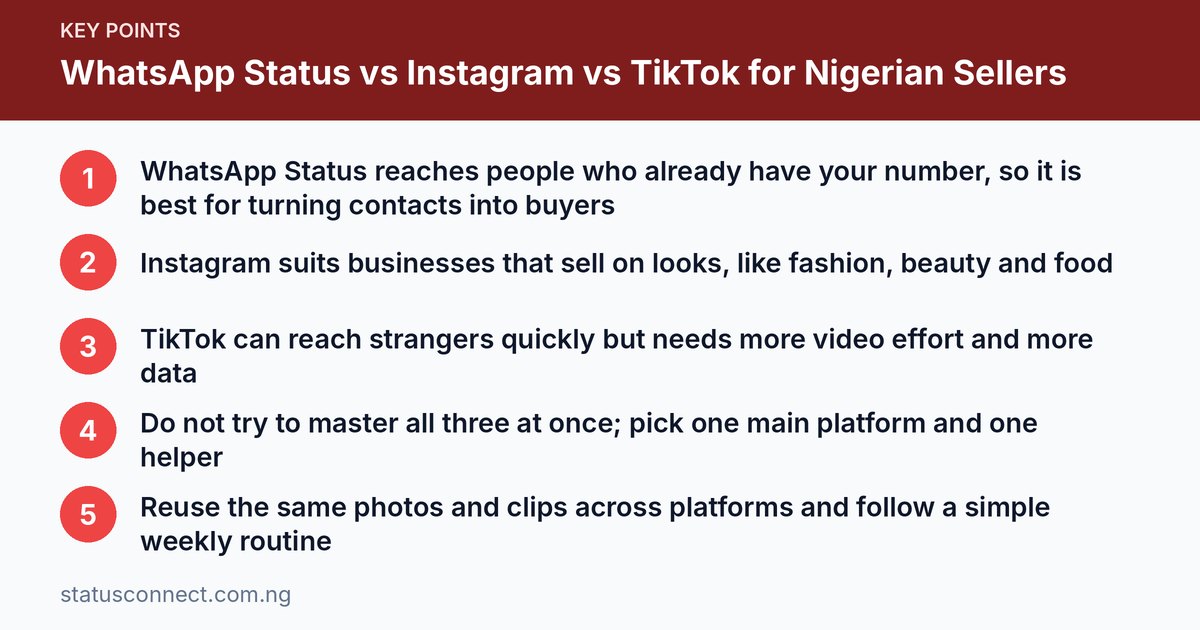
- WhatsApp Status reaches people who already have your number, so it is best for turning contacts into buyers
- Instagram suits businesses that sell on looks, like fashion, beauty and food
- TikTok can reach strangers quickly but needs more video effort and more data
- Do not try to master all three at once; pick one main platform and one helper
- Reuse the same photos and clips across platforms and follow a simple weekly routine
Every Nigerian seller eventually hears the same advice: "You need to be everywhere." Then they open three apps, post once on each, get tired and stop. The problem is not effort. It is that these platforms do different jobs, and trying to do all of them equally well on a small budget is a recipe for burnout.
This guide compares WhatsApp Status, Instagram and TikTok in practical terms: who sees your posts, what it costs in time and data, what content works and which platform suits which kind of business. At the end there is a simple weekly routine you can actually follow.
The short version
- WhatsApp Status is best for selling to people who already know you or have your number.
- Instagram is best for showing a polished catalogue of products and building a recognisable brand.
- TikTok is best for being discovered by strangers, if you are willing to make short videos regularly.
None of them is always better. The right choice depends on your product, your customers and the time you have.
WhatsApp Status: your warm audience
Status posts disappear after 24 hours and are seen mainly by contacts who have your number saved and who have not hidden your updates. That sounds limiting, but it is also the strength. These are people who already have some connection to you, so a Status post often feels like a message from someone they know.
Reach. Limited to your saved contacts, but those contacts are often the most likely to buy. Growing your contact list therefore grows your Status audience. Our guide on how to increase WhatsApp Status views in Nigeria goes deeper.
Cost. Free to use. You pay only for data or Wi-Fi.
Effort. Low. A phone photo, a short caption and a price are enough. No editing skills are needed.
Content style. Product photos, price drops, restock alerts, customer proof, short clips and "how to order" reminders. See content ideas for vendors.
Conversion. Strong, because the next step is a direct chat. A viewer can reply to your Status in seconds.
Weak points. You cannot easily reach strangers, posts vanish after a day and there is no public search by keyword. You can also check who viewed your Status, which is helpful, but depends on your viewers' privacy settings.
Instagram: your shop window
Instagram works like a visual portfolio. Customers can scroll your profile, see many products at once and judge your style before sending a message. It supports photos, carousels, Reels (short videos) and Stories (24-hour posts, similar to Status).
Reach. Followers see some of your posts. Strangers can find you through hashtags, search and Reels, but how widely your content is shown depends on the platform's changing system, so do not rely on any single trick.
Cost. Free to use. Paid promotion exists, but you can sell without it.
Effort. Medium. You need consistent visuals, decent photos, captions and a tidy profile. Stories and Reels take extra time.
Content style. Clean product photos, before-and-after shots, short tutorials, behind-the-scenes clips and customer results.
Conversion. Good, but usually with an extra step. Customers often see a product on Instagram and then move to WhatsApp or Direct Messages to order. Make that path obvious by putting your WhatsApp link in your bio. Our guide to the WhatsApp click-to-chat link and QR code shows how.
Weak points. Growing from zero can feel slow. Visuals matter more here than on Status, so poor photos hurt you.
TikTok: your discovery engine
TikTok shows videos to people based largely on what they watch, not only on who they follow. That means a new account can sometimes reach a large number of strangers with one good video. It can also mean a video gets almost no views, with little warning.
Reach. Potentially wide and unpredictable. You are not limited to your contacts.
Cost. Free to use, but video makes the heaviest demands on your phone storage and data. Uploading and watching videos can use a lot of mobile data, so consider Wi-Fi where possible.
Effort. Highest of the three. You need ideas, filming, simple editing and regular posting.
Content style. Short, lively videos: unboxing, packing orders, styling a product three ways, quick tutorials, "what N5,000 gets you" challenges, day-in-the-life at the shop, and honest answers to common questions.
Conversion. Slower and less direct. Many viewers are entertained rather than ready to buy. The sale usually happens after they follow you, visit your bio link or message you.
Weak points. Requires time, can be draining and does not always bring Nigerian local buyers if your products cannot be delivered widely. Delivery logistics matter: a viral video is little use if you only deliver within one Lagos area.
Side-by-side summary
Instead of a table, here is the same comparison in plain lines:
- Who sees it: Status shows to your saved contacts. Instagram shows to followers plus some discovery. TikTok shows to followers plus a lot of discovery.
- Time needed: Status is lowest, Instagram is moderate, TikTok is highest.
- Data use: Status is lighter when you post photos, but still adds up. Instagram is moderate. TikTok is usually the heaviest because of constant video.
- Best for: Status suits closing sales. Instagram suits showing a catalogue and brand. TikTok suits finding new people.
- Speed to first sale: Status is usually fastest. Instagram is moderate. TikTok varies.
Data and airtime: the practical side
For many Nigerian sellers, data cost is a real limit, not a footnote. Some habits help:
- Edit and upload on Wi-Fi when you can, such as at home, in the office or at a café.
- Turn off auto-download of videos in each app so you do not use data on content you do not need.
- Compress or trim videos before posting. Short videos use less storage and data.
- Use data bundles from your network. Plans and prices change, so check your provider's current offers rather than assuming old rates.
- Schedule heavy tasks like uploading a batch of clips for a time you have good network.
- Free up phone storage by backing up photos and deleting old clips. Our guide to moving WhatsApp chats to a new phone is useful if your storage problem is pushing you to upgrade.
Which platform fits which business?
These are general patterns, not rules.
- Fashion, shoes, bags, jewellery: Instagram as the main shop window, Status for daily offers and TikTok if you enjoy styling videos.
- Food, cakes and small chops: Status for daily menus and orders, Instagram for polished photos, TikTok for process videos.
- Beauty, hair and makeup: Instagram and TikTok for before-and-after results, Status for booking reminders.
- Phones, gadgets and electronics: Status for quick price and stock updates, plus trust-building proof. Instagram for reviews.
- Freelancers and service providers: Status for referrals and availability, Instagram for portfolio. See how freelancers find clients on WhatsApp.
- Local services like laundry, cleaning and repairs: Status and WhatsApp groups, because customers are nearby and want quick replies.
- Digital products or training: TikTok for reach, Instagram for credibility, WhatsApp for sales and support.
If you are still choosing what to sell, read about how to start a small business in Nigeria with low capital.
How to combine them without burning out
The best system is simple: one main platform, one supporting platform and one optional experiment.
- Choose your main platform based on where your buyers already are. For most beginners, that is Status.
- Create once, post many times. A single photo or clip can go on Status, an Instagram Story and, if it is a video, TikTok.
- Send everyone to one place to order. For most Nigerian sellers, that is WhatsApp. Put your WhatsApp link in every bio.
- Keep your name and look the same across platforms so people recognise you.
- Track what works. Note which posts brought enquiries, not just views. Likes are nice, but orders pay bills.
A simple weekly routine
This routine assumes about 30 to 45 minutes a day. Adjust it to your life.
- Monday: Take photos of your best products for the week. Post a "new this week" Status.
- Tuesday: Post a short video or photo showing how an item is made, packed or used. Reuse it on Instagram.
- Wednesday: Share customer proof, with permission, and reply to comments and messages.
- Thursday: Post a price, bundle or limited-stock offer on Status. See the best times in our guide to the best time to post WhatsApp Status in Nigeria.
- Friday: Post a more entertaining or educational piece for Instagram or TikTok, such as a styling idea or a common question answered.
- Saturday: Post a reminder of how to order, delivery areas and payment methods.
- Sunday: Rest, plan next week and note what worked.
If this feels like too much, cut it down to three posts a week and be consistent.
Mistakes to avoid
- Posting everywhere but replying nowhere. A fast reply matters more than a perfect post.
- Copying other sellers' photos. It damages trust and can get accounts reported.
- Spamming contacts. Posting ten Status updates in a row makes people mute you. Read the WhatsApp marketing rules.
- Chasing followers instead of buyers. Ten engaged local customers beat a thousand silent strangers.
- Ignoring product basics. If your price, photos and description are weak, no platform can save you.
Frequently asked questions
Which is best for a complete beginner?
WhatsApp Status. It costs nothing extra, needs no editing skills and reaches people who already know you. Start there and add Instagram once your photos and routine are steady.
Do I need all three platforms?
No. Many successful small sellers use only WhatsApp and Instagram. Add TikTok only if you enjoy video and your business can serve customers beyond your local area.
Is TikTok worth it if I only deliver in one city?
It can still work, because viewers in your city may find you, but views from other states may not convert. Make location clear in your videos and bio.
Should I pay for adverts?
Not at the start. Build a consistent organic routine first. If you later try ads, start small and check each platform's current rules and pricing. You can also read how to get customers without ads in Nigeria.
Final thoughts
The best platform is the one you can use consistently while customers are paying attention. Start with Status, use Instagram as your shop window and test TikTok when you have the time and data. Whatever you choose, make ordering easy and replies fast. You can also join the Status Connect community to grow your network of genuine contacts, and explore our guide to growing a business network on WhatsApp.
Platform features and data prices change often, so check each app's help pages and your network provider for current details.