Selling & Money · 7 min read
How to Price Your Products on WhatsApp in Nigeria and Still Make a Profit
A step-by-step pricing guide for Nigerian WhatsApp sellers covering true cost calculation, margins, competitor research, handling price changes and negotiation, with worked examples.
By Noah Precious · Published 3 August 2026 · Updated 28 October 2026

Key takeaways
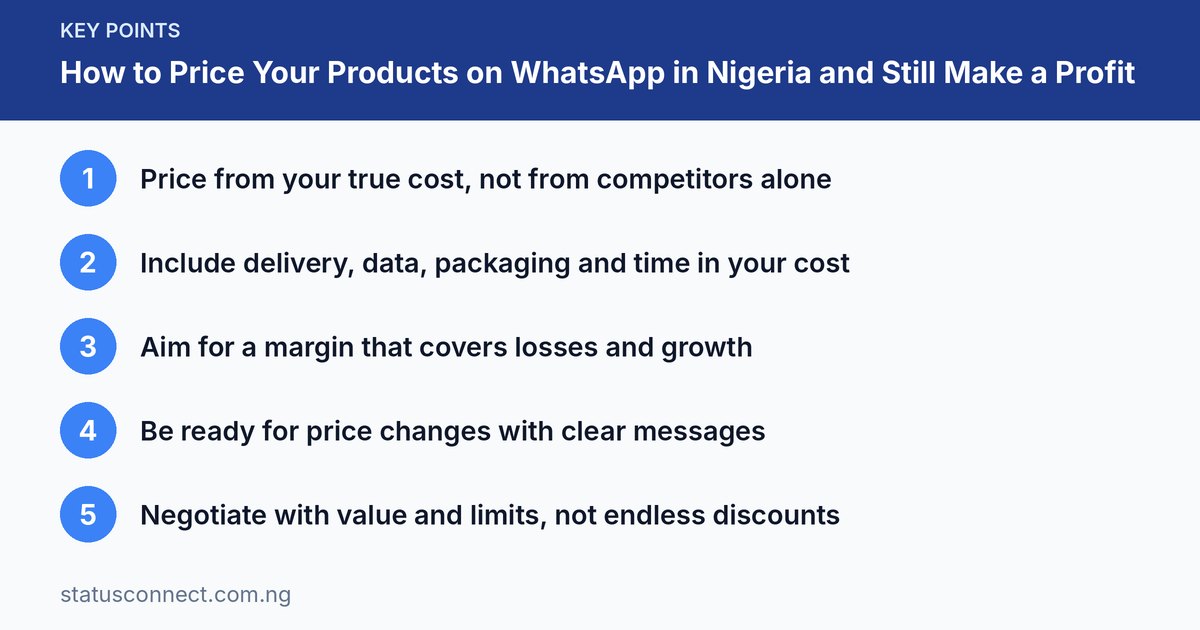
- Price from your true cost, not from competitors alone
- Include delivery, data, packaging and time in your cost
- Aim for a margin that covers losses and growth
- Be ready for price changes with clear messages
- Negotiate with value and limits, not endless discounts
Many Nigerian sellers price by copying what others charge, then wonder why they are busy but broke. Good pricing is not complicated, but it must start with your real costs and your goals. This guide shows you how to calculate your cost, choose a margin, check the market, handle changing prices and negotiate without giving away your profit.
Step 1: Know your true cost per item
Your cost is more than what you paid the supplier. Add everything:
- Purchase price of the item or ingredients.
- Transport from the supplier to you.
- Packaging such as bags, boxes, tape and labels.
- Data and airtime you use for customer chats and Status.
- Delivery if you pay for it.
- Payment charges or POS fees.
- Storage or rent divided across items.
- Losses, such as damaged, expired or unsold stock.
- Your time. Estimate what an hour of your work is worth.
Example
You buy a bag for N8,000 and pay N500 for transport. Packaging is N300, data and chat time about N200 and you set aside N500 for returns and damaged items. Your cost is N9,500, not N8,000.

Step 2: Choose a margin
Margin is the percentage of the selling price that is profit. Markup is the percentage added on top of cost. They are not the same, and mixing them up is a common mistake.
- If cost is N9,500 and you sell at N13,000, profit is N3,500. Markup is about 37 percent and margin is about 27 percent.
Many small sellers aim for a gross margin of 30 to 50 percent, depending on the product and competition. Fast-moving, high-volume items may need lower margins; custom or specialised products can support higher ones. Pick a target and compute prices from it.
Formula
Selling price = cost / (1 − target margin). For a 30 percent margin on a cost of N9,500: 9,500 / 0.7 = about N13,570. Round to a clean number such as N13,500 or N14,000.
Step 3: Research the market
Check what similar sellers charge on WhatsApp, Instagram, Jumia, Jiji and in markets. Compare quality, delivery, warranty and service, not just price. If you are more expensive, you need a reason customers can see: better materials, faster delivery, guarantees or great service. If you are cheaper, make sure it is sustainable and not a race to the bottom.
Step 4: Position yourself
- Budget: lowest price, basic quality. Needs volume and tight cost control.
- Mid-range: fair price, reliable quality. Works for most small businesses.
- Premium: higher price, better service or quality. Needs strong photos, reviews and presentation.
Your photos, packaging and replies must match your position. See our product photo guide.
Step 5: Show prices clearly
Hidden prices cost you customers. Put prices in your catalogue and Status. Our guide on the WhatsApp Business catalogue shows how. Make clear what is included: delivery, warranty, size. If delivery is separate, state the fee or the areas.
Step 6: Handle price changes
Prices in Nigeria can move quickly because of exchange rates, fuel costs and supply. Protect yourself:
- Review prices regularly, such as weekly for imported goods.
- Add a date to price lists: "Prices as at 3 March."
- Use a buffer for volatile items.
- Communicate changes honestly: "Due to supplier price increases, the new price from Monday is N15,000. Orders paid today are still N13,500."
- Do not change prices after payment unless the buyer agreed.
Step 7: Negotiate without losing profit
Haggling is part of Nigerian culture, so plan for it.
- Know your floor price, the lowest you can sell and still profit.
- Start with a fair price that leaves a small room for discounts, but do not inflate absurdly.
- Trade value for discount. Offer a discount for buying two items, paying in full now or collecting from you.
- Offer extras instead of price cuts, such as free delivery or a small gift.
- Be polite and firm. "That is the best I can do at this quality. I can add free delivery."
- Walk away when needed. A sale at a loss is worse than no sale.
Step 8: Use promotions wisely
Limited-time discounts can boost sales, but frequent discounts train customers to wait. Use promotions for specific goals: clearing slow stock, launching a product or rewarding loyal customers. Compute your margin at the discounted price first. For content ideas, see WhatsApp Status posts for vendors.
Step 9: Review monthly
Track what you sold, your revenue and your costs. Ask: which products make the most profit, not just the most sales? Which items sit unsold? Where do discounts eat your margin? Adjust prices or stop stocking items that do not earn.
Common pricing mistakes
- Ignoring delivery, data and packaging costs.
- Copying competitors without knowing their costs.
- Confusing markup with margin.
- Never raising prices when costs rise.
- Giving big discounts to every buyer who asks.
- Not recording sales and expenses.
Pricing services and custom work
Pricing a service is different because your main cost is your time. If you sew, bake to order, take photos or do hair, try this approach.
- Estimate the hours a typical job takes, including shopping, preparation, the work itself, chatting with the client and delivery.
- Decide what an hour of your time is worth and multiply.
- Add materials and transport.
- Add a small buffer for revisions or delays.
Offer packages such as basic, standard and premium so customers can choose by budget. Be clear about what each one includes. For custom jobs, quote in writing and take a deposit, as explained in our guide to accepting payments safely.
How to answer "How much last last?"
Nigerian buyers often ask for the final price in a way that invites a discount. Prepare a few calm replies in advance and save them as quick replies.
- "The price is N13,500 and that already includes careful packaging. For two items I can do N26,000."
- "I understand budget is important. I can offer the smaller size at N9,000."
- "This is my best price for this quality. If you pay today I can arrange delivery for free."
Notice that none of these simply cut the price. They change what the customer gets or what you receive, which protects your margin.
Frequently asked questions
Should I put my prices on Status or keep them private?
Showing prices saves time and filters out people who are not serious. If your prices change often, add a date or say "from" before the amount. Hiding prices usually leads to long chats that end with no sale.
What should I do when a competitor is much cheaper?
Do not copy them blindly. Check whether their quality, delivery or after-sales service is different. If it is not, look for ways to lower your own costs, or compete on reliability and presentation. A strong product description also helps justify your price, and how to write product descriptions that sell shows how.
How often should I raise my prices?
Whenever your costs rise enough to hurt your margin. Small, honest increases explained clearly are better than waiting until you are making a loss. Give regular customers a short notice before the change.
Is it wrong to charge more for delivery?
No, as long as you are open about it. Quote the delivery fee separately or include it in the price, but never surprise a buyer at the end of the conversation.
A quick worked example
You sell phone cases. A case costs N1,800 and you add N200 for packaging and N100 for data and delivery contributions. Total cost is N2,100. A 40 percent margin means a price of 2,100 / 0.6 = N3,500. You allow a discount to N3,200 if someone buys two. At N3,200 your margin is still about 34 percent, which is healthy.
Good pricing makes your business sustainable. When you are profitable, you can invest in better stock and marketing, and grow your WhatsApp network with confidence.