Selling & Money · 9 min read
How to Write Product Titles and Descriptions That Sell in Nigeria
Learn how to write clear product titles and descriptions for WhatsApp catalogues, Instagram and marketplaces, with before-and-after examples and Nigerian search terms.
By Noah Precious · Published 28 October 2026
Key takeaways
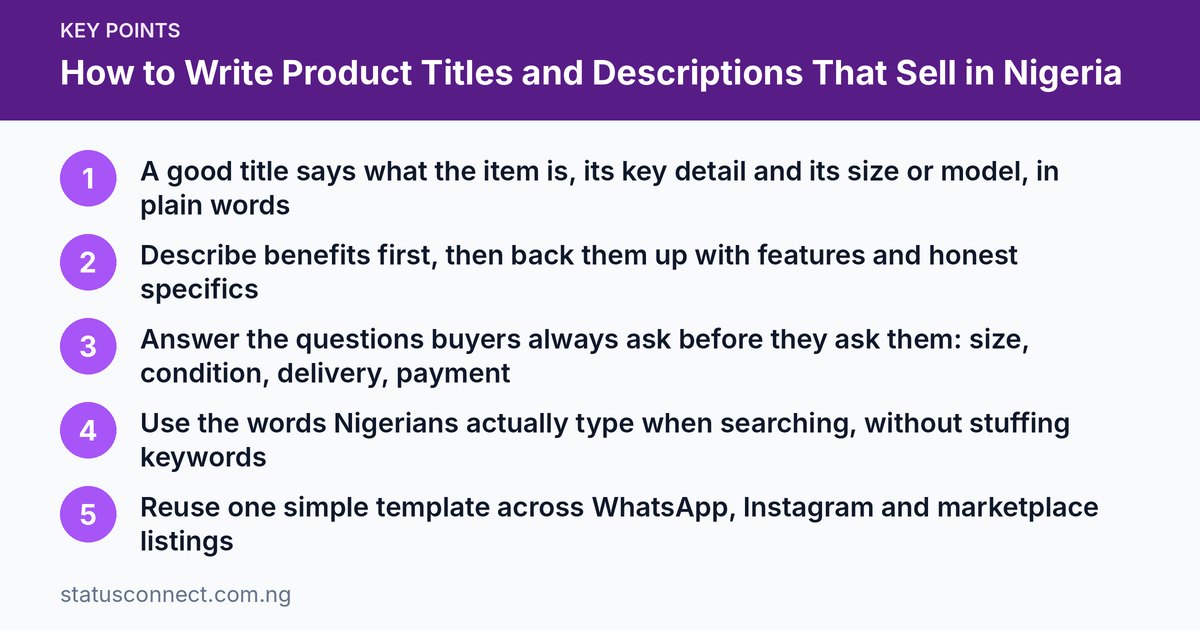
- A good title says what the item is, its key detail and its size or model, in plain words
- Describe benefits first, then back them up with features and honest specifics
- Answer the questions buyers always ask before they ask them: size, condition, delivery, payment
- Use the words Nigerians actually type when searching, without stuffing keywords
- Reuse one simple template across WhatsApp, Instagram and marketplace listings
Most Nigerian sellers spend time on the photo and then type "Available, DM for price." Then they wonder why serious buyers keep asking the same five questions. A clear title and description does half your selling for you. It answers questions in advance, shows you are serious and helps the right people find you.
This guide shows how to write product titles and descriptions for a WhatsApp catalogue, Instagram posts and marketplaces similar to Jiji or Jumia. You will get a simple structure, before-and-after examples for three product types, search tips and templates you can copy in your own words.
Why descriptions matter more than you think
A buyer scrolling quickly has little else to judge by. A photo catches attention, but the words decide whether they trust the item and whether they message you. A good description does three things:
- It saves time. Fewer repeated questions like "How much?", "What size?", "Do you deliver?" means more time for real sales.
- It filters buyers. When price, size and location are clear, the people who message are more likely to buy.
- It builds trust. Specific details feel honest. Vague claims feel risky. Our article on building customer trust when selling online in Nigeria explains why.
The structure of a good listing
Whatever platform you use, this order works.
- Title. What the item is, plus the one or two details people search for.
- One-line hook. The main benefit in a single sentence.
- Key details. Size, colour, material, model, condition, quantity.
- Benefits. What it does for the buyer.
- Terms. Price, delivery areas, payment method and how to order.
Keep it short enough to read on a phone in half a minute. If you need more space, use bullet points, not a wall of text.
Writing titles that work
A title is not a slogan. It is a label that helps people recognise and find your product.
A strong title usually includes:
- The product name in simple words, such as "Ankara maxi dress" or "Samsung Galaxy A-series phone case."
- A key detail such as size, colour, model, capacity or material.
- The condition, if relevant: new, fairly used or refurbished.
Good titles:
- "Men's black leather sandals, sizes 40 to 45"
- "Chocolate birthday cake, 8-inch, made to order"
- "Fairly used HP laptop, 8GB RAM, 256GB storage"
Weak titles:
- "Hot cake!!!"
- "Available now, come and buy"
- "Best quality, don't miss"
Avoid ALL CAPS, long strings of emojis and words such as "cheap" or "original" that everyone uses. If your item really is genuine, prove it with details, receipts or the supplier's information, instead of just saying so.
Benefits first, features second
A feature is a fact about the product. A benefit is what that fact does for the buyer. Both matter, but buyers care about the benefit first.
- Feature: "Cotton fabric." Benefit: "Soft and breathable, comfortable in Lagos heat."
- Feature: "10,000 mAh battery." Benefit: "Lasts through a full day of work, even with unstable light."
- Feature: "Non-stick surface." Benefit: "Fry eggs with very little oil and wash in minutes."
A simple formula is: "[Feature], so you can [benefit]." Use it where it feels natural. Do not exaggerate. If you cannot prove a benefit, leave it out.
Answer the questions buyers always ask
Think about the last ten chats you had. What did people ask? Put those answers in the listing.
- What sizes or colours do you have?
- Is it new, used or refurbished?
- How long does delivery take, and to which areas?
- How do I pay? Is there a deposit?
- Can I return or exchange it?
- Is the price negotiable?
- Where are you located?
If you are unsure how to set the price itself, see how to price products on WhatsApp in Nigeria.
Before-and-after examples
Here are three product types, with a weak version and a stronger version in plain prose.
Example 1: A fashion item
Before: "Nice gown available. Different colours. DM for price."
After: "Ankara midi dress, sizes 8 to 16. A fitted waist and flared skirt, sewn with cotton fabric that stays comfortable in warm weather. Available in blue, green and orange prints. Price is stated in the caption, and delivery within Port Harcourt is available. Message us your size and area to order."
What changed: the item type, size range, fabric, colours and delivery are all clear. The buyer can decide without asking.
Example 2: A food product
Before: "Cake for sale. Order now. Best cake in town."
After: "Chocolate birthday cake, 8-inch, serves about 10 to 12 people. Moist sponge with chocolate buttercream, and you can ask for a name on top. Please order at least two days ahead. Pickup is available in Yaba, and delivery within Lagos is available at a fee we will confirm before payment. Send your date and location to book."
What changed: the size, servings, flavour, lead time, pickup and delivery are all stated. Notice there is no unprovable claim such as "best in town."
Example 3: A used electronic item
Before: "Laptop for sale. Very clean. Urgent sale."
After: "Fairly used HP laptop, 8GB RAM, 256GB storage, battery holds a few hours of normal use. Screen has no cracks, and I can show a short video of it working before you pay. Tested charger included. Pickup in Abuja is welcome so you can inspect it. Please ask for the exact model details if you want to compare."
What changed: the buyer sees the condition, the specifications and the proof offered. Honest wording about "fairly used" builds trust, and "urgent sale" is removed because it can make buyers suspicious.
Search terms: use the words Nigerians actually type
Marketplaces and Instagram search reward clear, relevant words. You do not need tricks. You need the same words your customers use.
- Use the common name. If buyers say "tokunbo," "fairly used," "UK used" or "brand new," use the one that truthfully applies.
- Include model and size. People search "iPhone 11 128GB" or "size 42 sandals" more often than a generic name.
- Add your location. "Ikeja," "Wuse 2," "Rumuokoro" and similar area names help local buyers find you.
- Think of alternative names. "Slippers" and "sandals," "gown" and "dress," "handset" and "phone" are examples where buyers use different words.
- Mention the use. "Office wear," "school bag," "wedding guest outfit" or "gift for her" match how people shop.
Do not stuff a title with a long list of keywords. It looks like spam and may be penalised or ignored. Write for people first. For tips on getting more eyes on your listings without paying, see how to get customers without ads in Nigeria.
Adapting for each platform
WhatsApp catalogue. Fields are limited, so keep the name short and put details in the description. Add a clear price and a product link where available. The full process is in our WhatsApp Business catalogue guide. The exact fields may vary by app version, so check the WhatsApp Business website for current information.
Instagram. Use the caption for the story and key details, and put a "how to order" line at the end. Keep the first line strong, because it is what people see before tapping "more." Add your WhatsApp link in your bio.
Marketplaces like Jiji or Jumia. Follow the platform's rules for categories, photos and prohibited items. Listings are searched, so the title and the specifications matter most. Be honest about condition, and avoid sharing personal contact details in places where the platform forbids it.
WhatsApp Status. Status is quick and visual, so use one short line of text on the picture or in the caption, plus the price. Our guide to Status content ideas for vendors has more examples.
Description templates in prose
Adapt these in your own voice.
Template for a physical product: "[Product name], [size or model], [colour or material]. [One benefit sentence]. Condition: [new or used]. Price: [amount]. Delivery: [areas and timing]. Payment: [methods]. To order, message [what details you need]."
Template for a service: "[Service name] for [type of customer]. Includes [list of what is covered]. Takes about [time]. Price starts from [amount] and depends on [factor]. Available in [area]. To book, send [details]."
Template for a made-to-order item: "[Item name], made to order in [time] days. Choose from [options]. A deposit is needed to start, and the balance is due before delivery. Share your measurements or preferences when you order."
Mistakes to avoid
- Hiding the price. Some sellers do it on purpose, but many buyers simply move on. Where possible, state it or a starting price.
- Exaggerating. Claims you cannot prove cause disputes and bad reviews.
- Copying another seller's text and photos. It damages your reputation and may break platform rules.
- Skipping the condition. Not saying whether an item is new or used leads to arguments later.
- Poor spelling and no spacing. Read your text aloud before posting.
- Inconsistent details. If your caption says one price and your catalogue says another, buyers lose confidence.
- Ignoring photos. Great words need good images. See product photos with your phone.
Also be careful with claims about health, medical results or guaranteed outcomes. If your product is regulated, check the current rules before making such claims.
Frequently asked questions
How long should a product description be?
Long enough to answer the common questions, short enough to read on a phone quickly. For most items, three to six short lines or bullet points is plenty.
Should I put the price in the description?
Usually yes, because it filters serious buyers and saves time. If prices change often, say "from" and give the starting price, or update your catalogue regularly.
Can I use the same description everywhere?
Use the same core facts, but adjust the length and style. A marketplace needs more detail, while a Status needs very little. Keep the price and condition consistent.
How do I describe a used item honestly?
State that it is used, mention any flaws, offer a video and let the buyer inspect it where possible. Honesty may cost you a few buyers, but it protects you from disputes.
Final thoughts
Good descriptions are not about clever words. They are about being clear, specific and helpful. Write down the questions your customers always ask, answer them in your listing and keep the wording simple. Over time, you can build a bank of saved replies to speed things up. To go further, read our guide to growing your small business network on WhatsApp, or join the Status Connect community to reach more genuine contacts.
Platform rules and features change, so check each marketplace's current seller guidelines before posting.